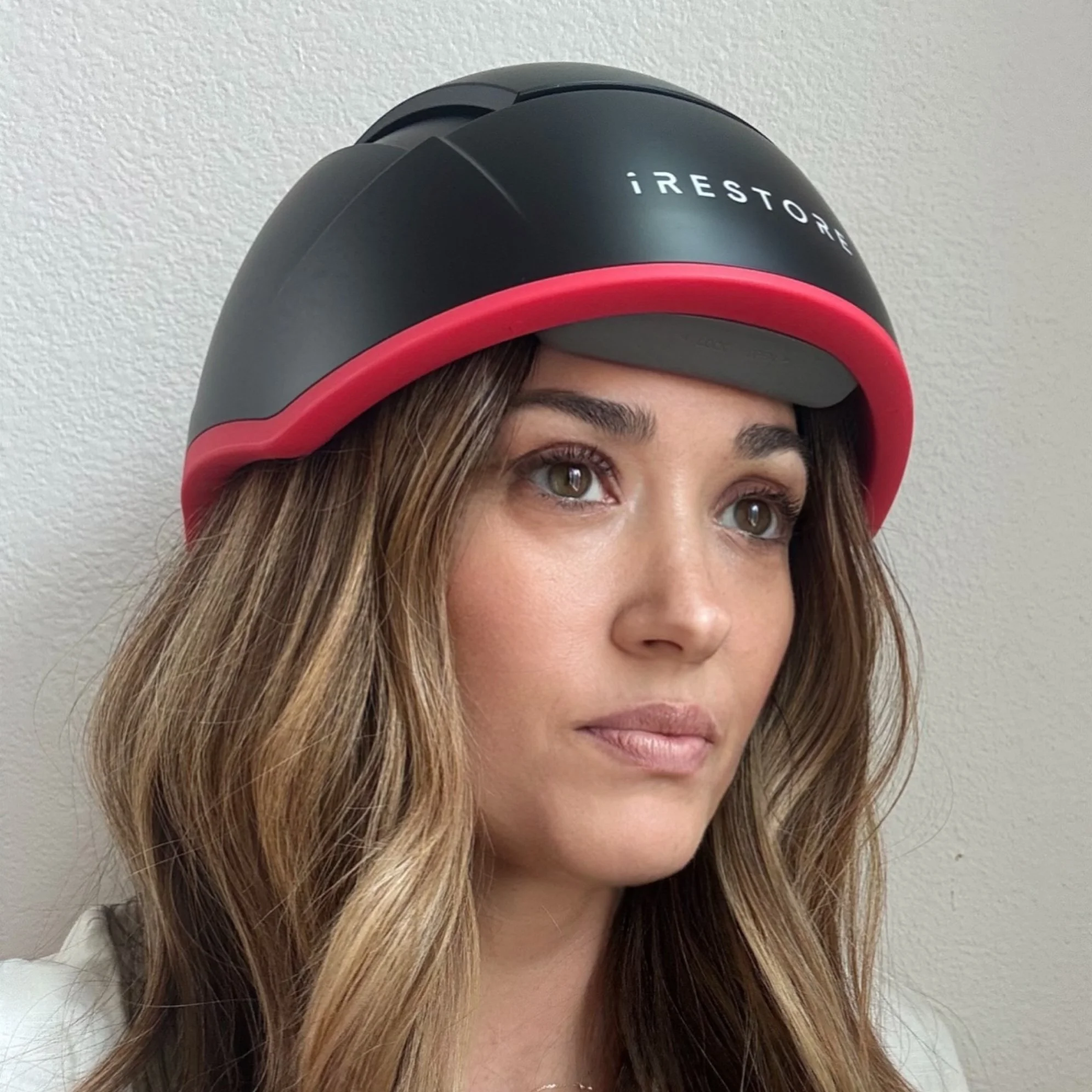
Red Light Therapy for Hair Growth: Why Elysian Head Spa Trusts the iRestore Elite
·
·
Hair loss can feel like an uphill battle — especially when you’re looking for options that don’t involve medications. Fortunately, red light therapy for hair growth offers a non-invasive, science-backed path to help stimulate hair follicles, slow shedding, and support greater hair density over time. At Elysian Head Spa, we trust the iRestore Elite as our red light therapy device of choice because of the clinical data showing meaningful, measurable results — and because it fits the kind of thoughtful, evidence-informed care we believe every client deserves.
What Is Red Light Therapy and How Does It Work?
Red light therapy (RLT) — also called low-level laser therapy (LLLT), low-level light therapy, or photobiomodulation — uses specific wavelengths of light in the red to near-infrared light spectrum to stimulate biochemical processes deep inside the hair follicles. This light energy acts like a gentle wake-up call to follicles that still have life in them, helping to restore healthier hair growth without medication or aggressive treatments.
Understanding how red light therapy works comes down to what’s happening at the cellular level.
Mitochondria and ATP Production
The wavelengths of light used in LLLT are absorbed by the mitochondria inside follicle cells, boosting the production of ATP — the energy that powers cellular function. Hair follicles that have become weakened or miniaturized, as is common in androgenetic alopecia, are essentially running on low fuel. Restoring ATP production gives those follicles what they need to function again.
Improved Blood Flow
LLLT improves blood flow to the scalp, delivering more oxygen and nutrients directly to the follicle. It’s the same reason scalp massage matters — follicles are living structures, and circulation is how they get fed.
Reduced Inflammation and Oxidative Stress
Photobiomodulation helps reduce the inflammation and oxidative stress around follicles that quietly contribute to hair loss over time, creating a healthier environment for hair regrowth.
Prolonging the Growth Phase
Hair follicles cycle through three phases: the anagen phase (active growth), the catagen phase (transition), and the telogen phase (rest and shedding). In people experiencing hair loss, follicles spend too little time in anagen and too much in telogen. Clinical research shows that LLLT can help prolong the anagen phase and stimulate dormant follicles back into active growth — which is where real hair regrowth begins.
What the Research Shows
Red light therapy for hair loss isn’t a wellness trend. It’s supported by a growing body of peer-reviewed research that gives us genuine confidence in recommending it.
A comprehensive review published in Lasers in Surgery and Medicine by Avci et al. evaluated LLLT for hair loss and identified strong biological and clinical evidence supporting its use for both male and female pattern hair loss, with a well-established mechanism rooted in photobiomodulation at the follicular level. A separate clinical study by Lanzafame et al. in the same journal found that visible red LED light produced measurable increases in hair density in men with androgenetic alopecia — pointing to real-world effectiveness for at home use laser devices.
Research published on PubMed examining photobiomodulation specifically in women with androgenetic alopecia found significant improvements in hair count and density following structured LLLT protocols. An additional clinical study also available on PubMed, evaluating LLLT results across hair growth patients, reported statistically significant improvements in hair count — further validating low-level light therapy as a legitimate hair loss treatment. And a 2020 systematic review and meta-analysis published in Dermatologic Therapy (Zhou et al.) found that LLLT contributed to notably improved hair density outcomes in patients with androgenic alopecia, reinforcing that this is a clinically serious tool, not a cosmetic novelty.
The picture that emerges from the clinical trials is consistent: when applied correctly using an FDA-cleared, medical-grade red light therapy device, LLLT can meaningfully improve hair density, slow shedding, and support new hair in both men and women, particularly those in the earlier stages of hair loss where follicles are still active.
Why We Use the iRestore Elite
Not all red light therapy devices are created equal, and that distinction matters when you’re making a decision about your hair health. The iRestore Elite earns its place at Elysian for several reasons that are clinically meaningful.
It’s FDA-cleared as a non-surgical, over-the-counter laser device for treating hair loss and thinning hair in both men and women — which means it has cleared the bar for a medical-grade designation, not just a cosmetic one. It uses 500 combined laser diodes and LED lights delivering roughly 2,500 mW of power, providing broad scalp coverage across the crown, temples, and hairline — the areas most commonly affected by pattern baldness and thinning hair. More laser diodes mean more of the scalp gets treated in each session, with less risk of coverage gaps.
The iRestore Elite also uses triple-wavelength technology at approximately 625, 655, and 680 nanometers — meaning different specific wavelengths of light reach follicles at different depths, stimulating more layers of hair growth across the scalp rather than working only at the surface. And the treatment protocol requires just 12 minutes per day, which matters practically: consistency drives results with LLLT, and a 12-minute session is far more sustainable to maintain long-term than longer or more frequent protocols.
The clinical data behind the device reflects all of this. A published clinical study on the iRestore reports an average of approximately 43% visible increase in hair count compared to placebo over 16 to 26 weeks in both men and women with pattern hair loss — a result that holds up against the broader body of LLLT research and gives us real confidence in recommending it to our clients.
Who It Helps and What to Realistically Expect
The iRestore Elite has shown effectiveness for both male pattern baldness across various Norwood-Hamilton stages and female pattern hair loss at Ludwig Class I–II. As with all forms of hair restoration, early intervention optimizes results — the more follicle activity that remains, the more LLLT has to work with. If follicles are completely non-viable, as seen in areas of advanced baldness, red light therapy won’t regenerate what is no longer there. But it can meaningfully stabilize areas that are actively thinning and encourage regrowth where follicles are still alive.
A few things are worth knowing before you begin. Consistency is everything — skipping sessions or using the device irregularly reduces outcomes significantly, and the clinical data is based on near-daily use over several months. Some people notice increased shedding in the first few weeks, which can feel alarming. In many cases, it’s a sign that follicles are cycling and newer growth is beginning. And the results build gradually: most clients begin to notice changes in shedding and early new hair by the three-to-six month mark, with continued improvement in hair density over time.
Supporting the process with good scalp health habits — gentle hair care, proper nutrition and protein intake, managing stress, and avoiding harmful styling practices — all help support the efficacy of LLLT and contribute to healthier hair overall.
Come Experience It at Elysian
You don’t have to navigate this alone or invest in an at-home device before you know if it’s right for you. At Elysian Head Spa in Austin, we offer iRestore Elite red light therapy sessions in a calm, clinically informed environment — so you can experience the treatment firsthand and get expert guidance on building a protocol that actually fits your life and your hair health goals.
If your hairline, hair density, or overall hair health has been on your mind, this is where to start.
References
• Avci P, et al. (2014). Low-level laser (light) therapy (LLLT) for treatment of hair loss. Lasers in Surgery and Medicine. https://onlinelibrary.wiley.com/doi/full/10.1002/lsm.22170
• Lanzafame RJ, et al. (2013). The growth of human scalp hair mediated by visible red light laser and LED sources in males. Lasers in Surgery and Medicine. https://onlinelibrary.wiley.com/doi/10.1002/lsm.22173
• Avci P, et al. (2017). Novel approach to treating androgenetic alopecia in females with photobiomodulation (low-level laser therapy). PubMed. https://pubmed.ncbi.nlm.nih.gov/28328705/
• Hegazy RA, et al. (2021). Results of low-level laser therapy in the treatment of hair growth: An Egyptian experience. PubMed. https://pubmed.ncbi.nlm.nih.gov/33713522/
• Zhou Z, et al. (2020). The effectiveness of combination therapies for androgenetic alopecia: A systematic review and meta-analysis. Dermatologic Therapy. https://onlinelibrary.wiley.com/doi/10.1111/dth.13741
• Bodian AB. (2017). iRestore Laser Hair Growth System: Double-blind, randomized, placebo-controlled clinical study. Conducted by Freedom Laser Therapy; directed by NST Consulting, LLC. https://www.irestorelaser.com/blogs/content/irestore-laser-hair-growth-system-is-now-clinically-proven-grow-hair
